MF / 01.06
Committees & Decisions
Keep Kneeling in a Church Chair Seating Plan
Define how kneeling will work before replacing church pews with chairs. Compare the proposed kneeler arrangement, front row and reset with the actual seating plan.
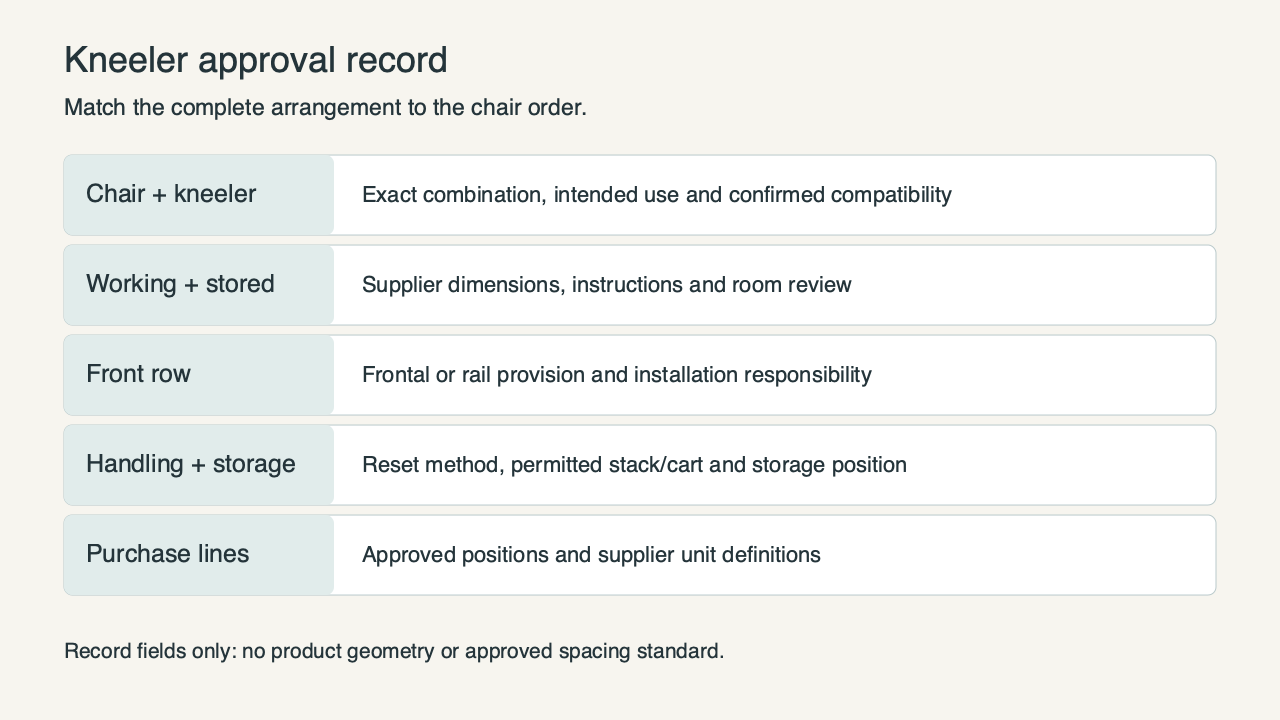
If kneeling is part of your congregation's worship, write it into the seating brief before choosing replacement chairs. Removing a pew can also remove the kneeler, the support in front of it and the fixed relationship between the two. A chair count alone does not replace those functions.
Begin with the worship leader and the people who use the room. Identify which services include kneeling, where it happens and what provision the church wants for people who remain seated or standing. The furniture committee's job is to carry those decisions into the purchase, rather than decide worship practice through an accessory choice.
Describe the whole arrangement
Record the current pew, kneeler and any frontal or rail together. Note whether the kneeler folds, stays in place or is moved for other uses. If something is to remain after pew removal, have a qualified person assess its installation and suitability for that changed arrangement.
Manufacturers offer different systems. Sauder Worship's kneeler page describes kneelers as part of its pew body. ChairsForWorship describes a sliding kneeler that stacks separately from its chairs. These examples establish two different furniture arrangements. They do not establish that an existing pew kneeler can be attached to a new chair, or that a separate unit suits any chair you select.
Ask a proposed supplier for the exact chair and kneeler combination, its intended use, dimensions and operating instructions. Identify which parts are connected, which are freestanding and which require installation. Any chair-mounted accessory needs explicit compatibility confirmation for the quoted chair. Do not improvise attachments or assume that similar finishes mean the parts belong together.
Review a row with the kneeler in use
Arrange the proposed chair and kneeler according to the supplier's instructions, with an adjacent row represented as well. Review it in its stored position and its working position. Include book racks and other accessories already in the chair brief; they occupy space too.
Have the facilities team and appropriate project advisers review the resulting routes and row arrangement. The dimensions need to cover the whole assembly in use, not just the chair's closed footprint. Use the actual room and applicable project requirements for that review. A general spacing number cannot approve it.
Invite participants to assess the worship movements they would normally make, within the product's intended use. Record whether they can reach and use the proposed arrangement comfortably and whether a moved part interferes with the next row. Keep alternatives available for people who do not kneel. Feedback should guide the furniture decision without becoming a claim about joint health or a prescription for how someone should worship.
The front row deserves a separate check. It may have no chair or pew in front of it. Identify any proposed frontal, rail or other provision explicitly, including its installation responsibilities. Do not assume that a chair back is intended to bear a person's weight as a support; ask the manufacturer about the proposed use.
Follow the pieces through a room reset
For a sanctuary that changes configuration, ask the setup team to describe the full reset. Where do separate kneelers go while the chairs are moved? How are they handled, stored and returned? If a folding component remains attached, what does that do to the permitted chair stack or cart arrangement?
Confirm those details with the supplier before budgeting handling equipment. A separate kneeler may require its own storage position even when the chairs fit on the existing cart. The pew replacement guide covers the wider removal and delivery sequence; keep this component's movements visible within it.
Build the order from approved positions, then identify the actual purchasing units. A shared kneeler is not necessarily one unit per chair, and a multi-position product is not automatically suitable for every row. Keep front-row pieces, standard rows and any retained provision on separate lines. Let the approved arrangement and supplier's unit definitions determine the quantities.
Give the supplier a kneeling requirement it can answer
Include these points in the furniture brief:
- The worship use to preserve and the seating arrangements that must also work.
- The proposed chair, kneeler and any front-row provision, with unresolved choices marked.
- Dimensions in both stored and working positions, plus the layout review still required.
- Confirmed compatibility, operating instructions and installation responsibilities.
- Purchasing units, approved positions and the storage or handling equipment needed.
For a custom chair discussion, use the Ministry Facilities furniture inquiry and state that kneeling provision is part of the project. Ask whether the supplier can offer or coordinate a suitable system before approving the chair choice. A kneeler is an unconfirmed requirement until that question is answered. If it needs a separate specialist supplier, keep its specifications and delivery obligations beside the chair order so neither purchase silently assumes the other will solve it.