MF / 01.05
Committees & Decisions
Choose Church Choir Chairs With a Rehearsal Trial
Compare proposed choir chairs using actual music folders, seated and standing passages, instruments and rehearsal-room tasks before placing an order.
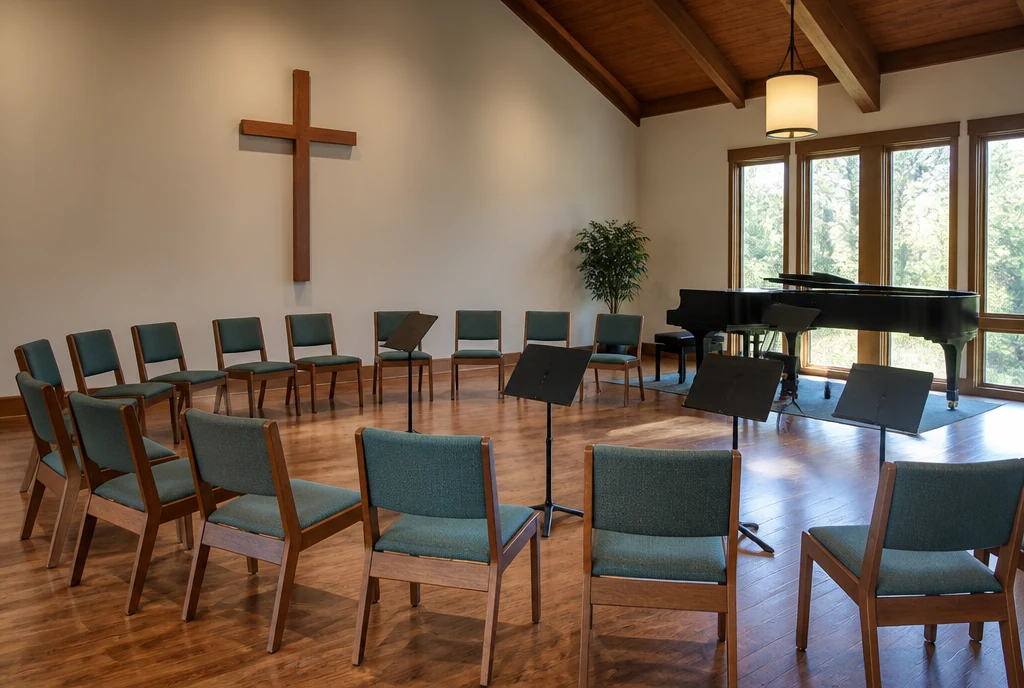
Bring the rehearsal folder to the chair trial. Bring the music stand, an instrument where one is used, and the robe if singers rehearse or perform in it. A chair that looks right beside the sanctuary furniture still needs to work while someone follows the conductor, turns a page and stands for the next passage.
Ask the music director to describe the chair's job before the committee selects a design. Some choirs rehearse seated and sing standing; others remain seated for part of a service. Instrumentalists may share the space without needing the same chair. Record those differences rather than buying one configuration simply because the upholstery matches.
Choose the sample tasks with the music team
Agree on a short sequence drawn from your own rehearsal. Have singers use their usual folder or stand, turn pages, look toward the conductor and move between the seated and standing positions they actually use. Keep the trial within the manufacturer's intended use. It is a furniture comparison, not a test of how far someone can stretch or balance on a chair.
Invite feedback from people with different chair preferences and access needs. Ask what they could do comfortably and what required an awkward adjustment. “The chair felt fine” is less useful than “the arm met my folder when I turned toward the conductor.” Do not turn a person's response into a medical conclusion or assume that one participant represents everyone.
For instrumentalists, include the actual playing position and the space occupied by the instrument. An arm, rack or rear leg may matter differently beside a guitar, a bowed instrument or a music stand. The musician should identify that conflict; the committee should not decide it from a photograph.
Compare configurations, not promises about performance
Wenger's Nota Standard page lists multiple seat heights and music accessories. Its Musician Chair page describes an upholstered music chair and identifies choir use. Those are examples of different configurations to investigate, not evidence that a particular chair will improve your choir's singing or suit every member.
Request the current seat dimensions, overall footprint, arm details and available configurations for each sample. If several heights or shapes are proposed, label the samples so feedback stays connected to the correct version. Avoid borrowing a classroom purchasing ratio for an adult church choir. Your trial and the supplier's current options should determine which variants remain under consideration.
Check any proposed music rack with the actual folder. Can the folder be put away and retrieved without displacing someone else's instrument or reaching through another chair? If the choir already uses separate shelving, a rack may add an accessory without solving a storage problem.
Set the chairs in a rehearsal arrangement
Place the sample chairs with the music stands and equipment in the intended arrangement. Ask the singers to look toward the conductor from the positions they use. A trial in a circle around a committee table does not answer the same question as a rehearsal row.
Have the responsible facilities team review routes, platform edges and any proposed use on risers. Do not infer platform capacity or an approved seating layout from the number of chairs that can be placed there. A floor-level rehearsal sample also does not approve the same chair on a different platform.
If the chairs move between rooms, test the actual handling arrangement separately, using the supplier's permitted stack and compatible cart. Include the chosen arms and racks in that confirmation. The portable church chair guide covers transport planning in more detail. Choir fit still needs its own result even when a chair moves easily.
Turn observations into a small chair list
Give each proposed configuration its own trial sheet. Record the task, what happened and the resulting purchase decision:
- Follow the conductor with music open. Note the folder or stand position, chair orientation and any arm conflict. Identify what needs to change in the proposed configuration.
- Move between seated and standing passages. Record participant feedback and interference from robes or nearby equipment. Retest a changed arrangement before approval.
- Play an instrument. Record the musician's position and contact with arms, racks or adjacent chairs. Identify a separate instrumentalist chair if needed.
- Put music away. Note actual folder fit and access. Choose a suitable rack or keep the existing separate storage.
- Return the room to its next use. Record the confirmed handling method and where each variant goes. Label approved chair groups and storage positions.
The music director can recommend the working chair mix; the church's purchasing authority can approve the order. Keep those roles clear without asking either person to approve matters outside their responsibility. If a sample changes, repeat the affected tasks before treating it as the approved chair.
Use the church chair inquiry to describe the choir's tasks, approximate quantities and any different configurations identified by the trial. Ask what suitable options and samples the supplier can provide. Specialized music chairs, accessories and different heights need confirmation; the inquiry does not establish that they are available. Keep the choir's requirements alongside the congregation's chair brief, with enough detail that a matching finish cannot erase a different furniture job.