MF / 01.04
Committees & Decisions
Writing a Building Use Policy Before You Need One
A committee-friendly guide to church building use policy: outside groups, fees versus donations, keys, insurance certificates, calendar authority, and saying no with grace.
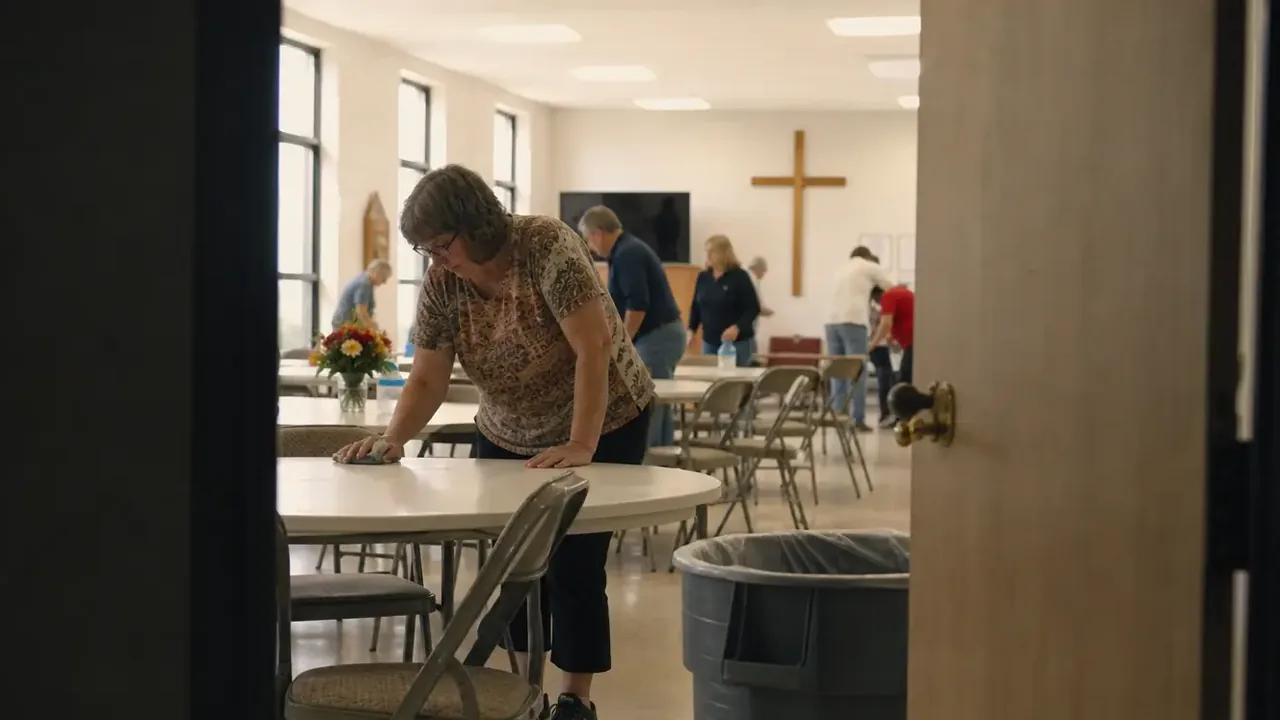
The request always arrives on a Tuesday, and it always sounds simple. A member's daughter wants the hall for a baby shower. A yoga instructor asks about Thursday evenings. A community choir needs a rehearsal space, a scout troop needs a home, a neighbor wants the parking lot for a garage sale. Each request is reasonable. Each is slightly different from the last one. And each gets decided by whoever happens to answer the phone, based on precedent nobody wrote down and everybody remembers differently.
This works until it doesn't. The year it stops working is the year two groups believe they booked the hall for the same Saturday, or a member discovers that an outside group paid less than her family did for a funeral reception, or someone asks a question about alcohol at a rented event and the board realizes it has never actually decided. The damage in these moments is rarely about the building. It is about fairness, and the perception that decisions are being made by relationship rather than by rule.
We want to persuade you to write a building use policy now, while no request is pending and no feelings are at stake. A policy written in peacetime is an act of hospitality. A policy written in the middle of a dispute is a weapon, whatever it says.
Start With Why You Say Yes

Before the committee drafts a single rule, spend one meeting on a more interesting question: why does this congregation share its building at all? The answers vary honestly. Some churches see weekday use as ministry: the building serving the neighborhood the way the congregation wishes it could. Some see it as stewardship: a heated, insured, mortgage-carrying building that sits empty six days a week is a resource being wasted. Some see it mostly as a source of modest income. Most see some mixture.
Name your mixture, because it drives everything downstream. A congregation that shares its building as ministry will price differently, schedule differently, and say yes to different groups than one balancing a budget. There is no wrong answer, but an unnamed answer produces incoherent decisions: a food pantry charged like a business one year, a business hosted free the next. If the building is going to work this hard, it is also worth reading our companion piece on planning the hardest-working room in your church, because policy and room design succeed or fail together.
The Questions Every Policy Must Answer

A workable policy fits on two or three pages. It should answer, plainly:
- Who may use the building? Most congregations define tiers: congregational ministries first, members' personal events second, community nonprofits third, private outside groups last. Tiers make priority decisions explainable instead of personal.
- Who decides, and how far in advance? Name the person or small group with calendar authority (more on this below).
- What does it cost? Whether you charge fees, suggest donations, or host free, write the numbers down and apply them evenly. Unevenness, not the amount, is what wounds.
- What is expected afterward? The room reset, the trash out, the thermostat returned, the lights off, the door locked. Put it on one sheet and hand it to every user.
- What is simply not available? Some spaces (the sanctuary in many traditions, the nursery in nearly all) carry restrictions worth stating up front, and the nursery's are safety matters we cover in our children's space walkthrough.
Fees, Donations, and the Tax Question
Whether to charge outside groups is partly a values question and partly, in both the United States and Canada, a question with tax dimensions: regular rental income can have implications for a congregation's tax treatment, and the rules differ by country and by circumstance. We will not pretend to summarize them here, because this is exactly the territory where a policy should say: significant or recurring rental arrangements are reviewed with our treasurer and, where warranted, a professional advisor. The IRS publishes guidance for religious organizations at irs.gov/charities-non-profits, and the Canada Revenue Agency does the same for charities in Canada; both are better starting points than the parking lot conversation where most fee schedules are currently set.
Inside the congregation, the fee-versus-donation choice is mostly about clarity. Suggested donations feel warmer and collect unevenly; fixed fees feel cooler and collect fairly. Either works if the policy states which one applies to whom, and nobody discovers the answer by comparison after the fact.
Insurance, Keys, and the Unromantic Middle
Two unglamorous items sink more building-sharing arrangements than any philosophical dispute.
Insurance. Your congregation's policy covers your congregation's activities. Whether it covers a karate class, a private party, or a contractor renting your kitchen is a question for your insurer, before the arrangement begins, not after an incident. Many churches ask regular outside groups to carry their own liability coverage and provide a certificate of insurance naming the congregation; whether that is right for you is between your board and your insurer. The policy's job is to make sure the question is always asked. One phone call per new group is cheap. The alternative is not.
Keys. Every congregation that shares its building eventually discovers it no longer knows who can open it. Keys duplicate, migrate, and outlive the arrangements that justified them. Your use policy should own this problem: who issues keys or codes, who keeps the list, and when access is reviewed and retired. We have written a whole companion piece on keys, security, and the open door, because the subject deserves more than a clause.
Calendar Authority: One Book, One Keeper
Double-bookings are the most common building-use failure and the easiest to prevent. The fix is almost embarrassingly simple: one calendar, one person (or one small team) with authority to write in it, and a rule that nothing is booked (not by the pastor, not by the founding family, not by the chair of anything) except through that calendar.
The keeper of the calendar needs the board visibly behind them, because their job is occasionally to tell an important person that the hall is taken. A congregation that undermines its scheduler by making exceptions around them will be back to double-bookings within a season. Give the role authority, a deputy for vacations, and public gratitude at least annually.
Alcohol, Weddings, and the Questions Traditions Answer Differently
Some questions cannot be settled by any article, because they are genuinely questions of tradition and conviction: whether alcohol may be served at events, what kinds of ceremonies may take place in which rooms, what outside religious groups may use the space, what happens on the sabbath your tradition keeps. We will not suggest answers. We will insist on one thing: answer them in advance, in writing, as a board, because these are precisely the questions that should never be decided improvisationally, by a volunteer, on the phone, under pressure from someone's beloved cousin. Where local law also has opinions (liquor licensing, occupancy limits, food service rules), the authority having jurisdiction has the final word, and your policy should say so.
Saying No With Grace
A policy's quiet gift is that it lets your people say no without saying I refuse. "Our policy reserves the hall for member events that weekend" lands entirely differently than a personal judgment, and it protects the volunteer who delivers it. Train everyone who fields requests to answer with the policy, offer an alternative when one exists (another date, another room, another venue down the street), and route appeals to the committee rather than debating at the door.
And build in a review. A use policy should be reread by the property committee or board every year or two, because the neighborhood changes, the congregation changes, and a policy that no longer matches practice is worse than none. It teaches people that your written rules are decorative. Ours is a conviction we hold across all of this work, from chartering the property committee itself onward: write down what you decide, apply it evenly, and revisit it honestly. A building shared on those terms blesses everyone who walks in, and stays a blessing to the congregation that holds the keys.