MF / 05.02
Children & Family Spaces
Safe Environment Policy Basics: The Shape of a Policy That Protects Everyone
The principles behind a children's safety policy: two adults, sight lines, windows in doors, screening, and how your building either helps or fights them.
Every church wants children to be safe. A written safeguarding policy is one part of making that commitment operational; it does not guarantee safety and it cannot replace training, supervision, reporting, and professional review. This article is a facilities checklist for supporting a church's adopted policy, not a model policy.
Start with current legal and safeguarding advice for the church's exact location and activities. In the United States, mandated-reporter categories and procedures vary by state; in Canada, reporting duties are set by provincial and territorial law. The CDC's youth-serving-organization framework describes six coordinated components: screening, interaction rules, monitoring, safe environments, response procedures, and training. A church should build all six with its insurer, denomination or safeguarding specialist, and legal counsel where needed.
Why the Policy Comes Before the Incident
Written rules establish boundaries consistently and make supervision, correction, and reporting easier. They reduce avoidable one-to-one isolation and clarify what adults, youth leaders, parents, and supervisors should expect. They do not prove that abuse cannot occur or that an allegation cannot be made; the church still needs a prompt response plan that prioritizes child safety and follows the law.
The other reason the policy comes first is that it cannot be written well afterward. A policy drafted in the heat of an incident will be shaped by that incident: too specific in one direction, blind in the others, and adopted by a board that is grieving instead of thinking. Write it in peacetime. Review it in peacetime. The property committee's regular calendar is a fine place to anchor the annual review.
The Two-Adult Rule
Many organizations use a two-adult or observable-and-interruptible interaction rule, but the exact rule, adult-to-child ratios, transportation requirements, age distinctions, and exceptions must come from the church's approved safeguarding policy and applicable law. Do not invent a universal rule from this article. Whatever standard the church adopts should address classrooms, nursery care, transportation, counseling, electronic communication, overnight events, and emergency exceptions.
The property plan must support the approved staffing and monitoring rules. If the volunteer roster cannot support every open room, leaders may need to consolidate age groups only where the program, room capacity, supervision ratios, accessibility, and safeguarding policy allow it. “Out of compliance” is a determination for the church's actual policy and governing rules, not this guide.
Sight Lines, Windows, and Open Doors
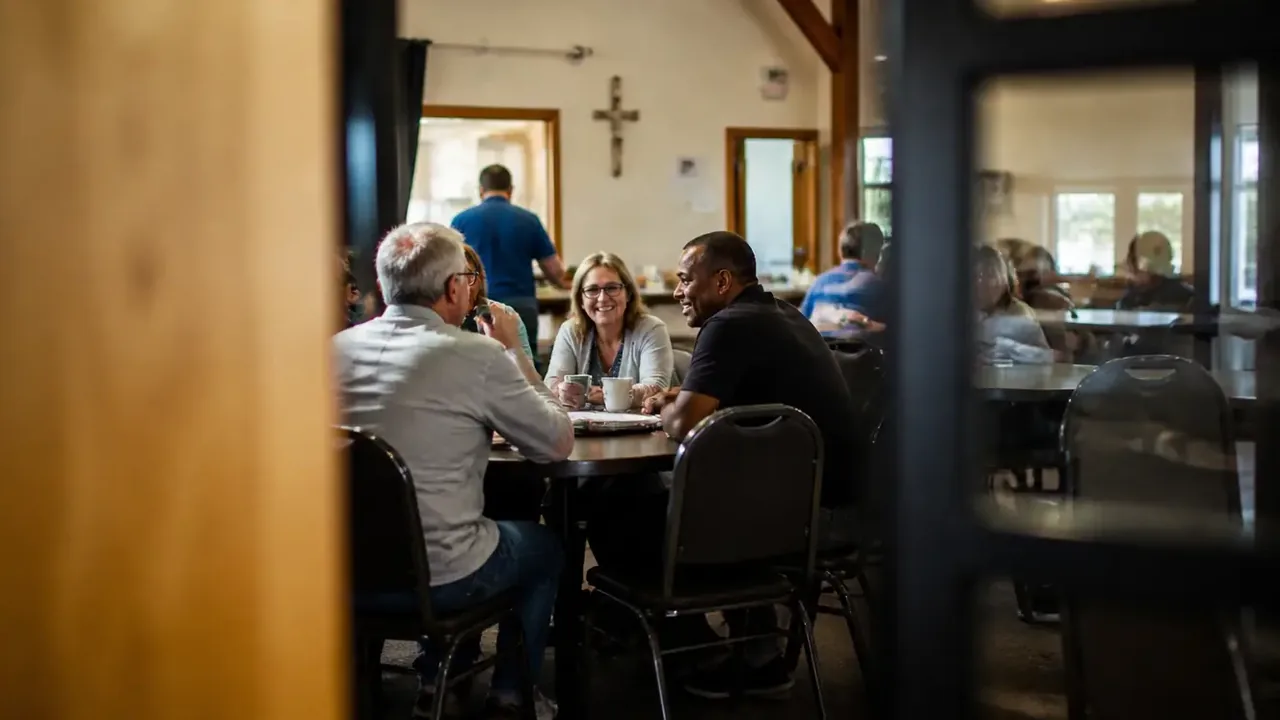
Visibility can support monitoring, but glazing and open doors are not substitutes for adequate staffing or active supervision. Review each space against the adopted safeguarding plan, fire and egress requirements, privacy needs, accessibility, and any security concerns.
- Windows in doors. A vision panel may improve passive observation where the room, door rating, privacy requirements, and local code allow it. Have a qualified door or fire-protection professional review modifications to any rated or egress door; cutting a window into a door is not automatically a modest carpentry job.
- Sight lines inside rooms. Walk each children's room and ask what a person standing at the door cannot see. Tall shelving, alcoves, and blanket forts all create blind spots; so do supply closets big enough to enter. Arrange the room so that supervision is a glance, not a search. The same walkthrough logic we use for the nursery applies to every room down the hall.
- Open doors. Do not prop open a fire door or defeat required security. If an open-door practice is part of the safeguarding plan, confirm it with the fire-safety and security requirements for that opening.
- Restrooms and personal care. The approved policy should address accompaniment, toileting assistance, privacy, disability-related support, documentation, and reporting. Use guidance written for the applicable age group and program rather than a single slogan.
None of this requires new construction. Most of it requires furniture moved, a few doors modified, and a floor plan looked at with fresh eyes, the sort of items a volunteer facilities audit surfaces naturally when you add "can I see into every children's space?" to its checklist.
Screening, Training, and the Waiting Period
The paperwork side of the policy has three standard parts, and your insurer or denomination will have specific expectations for each.
- Screening and selection. Use written applications, references, interviews, identity checks, and legally appropriate record checks as advised for the jurisdiction and role. A record check alone cannot determine fitness. Apply the approved process consistently and renew or re-screen on the schedule set by the policy and applicable authorities.
- Training and reporting. Volunteers should know the interaction rules, signs of abuse and neglect, internal escalation steps, and the direct external reporting procedure required by law. An internal report must never be allowed to delay a legally required report. The US Child Welfare Information Gateway summarizes state treatment of clergy; the Government of Canada explains that each province and territory requires reports of suspected child abuse. Use the current local authority's instructions.
- The waiting period. Many policies ask that a newcomer be part of the congregation for a set season before serving with children. It is a gentle rule that costs little and screens out the rare person who arrives seeking quick, unsupervised access.
If numbered lists feel bureaucratic for a volunteer culture, remember what they buy: a church that can welcome new helpers warmly and quickly because the path is defined, instead of improvising trust case by case.
Check-In, Pick-Up, and the Edges of the Hour
A surprising share of safety policy lives at the edges of the program hour: the moments when a child changes hands. Who may drop a child off, who may pick a child up, and how the room knows the difference are questions with real answers, and they deserve their own system. We cover that machinery in children's check-in basics; for policy purposes, the principle is simply that a child is released only to the person authorized to receive them, verified the same way every week, even when, especially when, the volunteer knows the family.
The building participates here too. A children's wing with one clear entrance is far easier to govern than one with three casual ones; signage that tells a visiting family exactly where to go is a safety feature as much as a hospitality one; and the locking-up routine should include a sweep of children's spaces before the building goes dark.
Big Days and Borrowed Spaces
Policies written for a quiet Sunday must also survive Christmas Eve, Easter, and the crowded week of vacation Bible school, when volunteer rosters stretch and unfamiliar rooms get pressed into service. The policy should say explicitly that its rules do not relax on big days: two adults, visibility, and check-in hold even in overflow spaces. And when outside groups use your building for children's programming, your building use policy should require that they carry their own safeguarding rules and insurance rather than borrowing your silence.
Keeping It Alive
A safe environment policy is not a document; it is a practice with a document attached. Review it annually with your insurer's current guidance. Re-train when the policy changes and when new volunteers arrive. Walk the building once a year asking only the visibility questions. And when a volunteer says a rule feels awkward, thank them, then explain whom the rule protects, because the honest answer is: everyone, including them.
Churches that do this discover something unexpected. Far from making the congregation feel suspicious, a visible, well-run safety culture is one of the most reassuring things a young family can encounter. It says: this church has thought about my child before I arrived. Few welcome mats say more.